History of Libertad
THE HISTORY OF LIBERTAD
 The town of Libertad in Antique was formerly a barrio of the town of Pandan, until President Elpidio Quirino’s Executive Order Number 2531 made it into a municipality on August 5, 1949. It was finally inaugurated on October 18, 1949 with Atty. Daniel Dujali as the appointed Municipal Mayor. Mayor Dujali administered the town from September 1949 until December 1951. It was in 1951 when Libertad had its first municipal election. Arsenio Nicopior was the first elected Mayor, who won by protest over his close rival Primitivo Garmillos. In 1955, Primitivo Garmillos became the second elected mayor. In the 1967 local elections, Primitivo Garmillos gave way to Burgos Nicopior. During the years of martial law until 1986, Burgos Nicopior administered the town. After the EDSA Revolt, by virtue of the executive order of the President Corazon Aquino, Ireneo Ambong was appointed mayor as the transition period from martial law underwent. Spanish Watch Tower During the Spanish era, barrio Inaywan or Inyawan was first located at Potipos, a place enclosed with a robust wooden fence. Due to the frequent attacks of the Moro pirates, the barrio folks built a watch tower on the eastern side of the mouth of the Inaywan or Inyawan River, now called Magsapad. The area had twelve (12) houses, a stone tower and a stone church. Much later, four wooden mills were constructed in Agungon, Inyawan (Balud), Carajon (Codiong), and Malatibok (now part of Panangkilon) respectively. But on February 5, 1855, Moro pirates burned the house of Teniente Owa, robbed the barrio folks and murdered one man. With the migration of many settlers from the southern portion of the province, the barrio grew and progressed which prompted the Spanish authorities to impose taxes known asmontes. The people were made to contribute in money or in kind to support the Spanish friars and officers. This system, as well as the imposition of forced labor, caused the eventual retreat of the barrio folks to the frontiers, thus, the barrio was considered "abandoned" - a word which locally means inaywan or binaya-an hence the name Inyawan was derived. Philippine Revolution In 1896, the struggle of the Filipinos for independence from the Spaniards began. The revolt spread all over the island of Panay. In 1898, Gen. Leandro Fullon, a revolutionary leader together with his men, landed at Punta Pucio. For four months, his command stationed at a cave at Mt. Agongon, as it was pursued by the Spanish soldiers. In November 1898, the Spanish forces arrested Fullon but he was able to escape for unknown reason. Instead of Fullon, Ignacio Umilongo and his nephew named Felix Unilongo were arrested and presented to the Spanish General at Pandan. They were rescued however, by Gen. Fullon who made a diversionary declaration to the Spanish authorities by telling them to meet him in a battle in Culasi. Ignacio and Felix were set free by the Spaniards. The revolutionary general on the same week changed the names of the following barrios: Inyawan to Libertad; Nipa toUnion; Nabat-a to San Roque; and Tinawagan to Patria. Libertad is a Spanish word for freedom, while union for unity, patria for fatherland, and San Roque, the patron saint of the wounded. The choice of words were descriptive of the plight of the revolutionary army and the barrio folks at this period of transition. In November 1891, General Fullon organized the municipalidad de Libertad under the revolutionary government and appointed Ignacio Unilongo as the presidente municipal and Pedro Depuno as the tresorero municipal. The municipality remained unrecognized, however, due to the crisis in the revolutionary government and administration. In 1899, when the American forces came, they started to administer the community and educate the people, establishing the first public school with Delfin Rodillon as the first mentor. In 1909, the Philippine Independent Church was established in Libertad, with Fr. Leopisto Pacite as the first parish priest. World War II During the advent of the World War II, four other houses were built of concrete materials. When the Japanese occupied the country, the guerrilla movement was organized in the Island of Panay, making Libertad or Inyawan as the center of guerilla activities. The guerilla forces under Col. Cirilo Garcia were victorious over the Japanese. This made the enemy so furious that they burned the barrios of Taboc, Olaog, and the hiding place or camps in Magpiyong . With the coming of the Americans in 1945, the locality was liberated. Situation returned to normal. All ruined structures including school buildings were reconstructed. During World War II, American Submarines docked at the bay of Inyawan or Libertad to unload arms, ammunitions, and all necessary war supplies for the Panay guerilla forces that helped liberate the whole Panay Island from the Japanese. Mt. Agungon became a secret bodega of Panay guerilla arms and other military supplies, including cash for the salary of the soldiers. Mysteriously though, the said bodega was burned. Two civilians were suspected of burning it. The findings proved that the two guards who were assigned there were answerable and were there for shot to death as punishment. It was here in Libertad that the American civilians in Panay and Negros were gathered to be whisked away by the American submarines to Australia.
Libertad is now composed of nineteen
(19) barangays.
Administratively the Municipality of Libertad is subdivided into 19 barangays. 2 compose the center of the city wheras the other 17 are in the outlying areas. Some of them are even several kilometers away from the center of the Municipality.
According to the 2007 census, Libertad has a population of 14,653 residents and is part of the big group of 1073 cities and municipalities in the Philippines which have more than 10.000 residents but did not reach 50.000 population yet. Based on the number of its inhabitants Libertad is number 1375 of the most populous cities of the Philippines and at 331 in Visayas group of islands and at 17 of the most populous cities of province Antique. With an area of 97.00 km² Libertad is one of the cities with a smaller urban area. Based on its area area, it ranks only as the 15th of the smallest cities of the province of Antique.
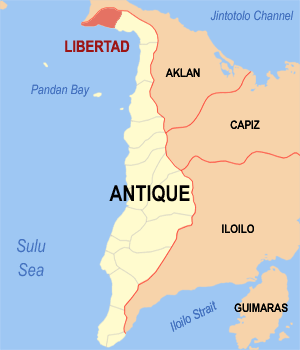
According to the Philippine income classification for provinces, cities and municipalities Libertad is a 5th class municipality. The urbanization status of Libertad is classified as partly urban. Among the bigger cities and municipalities in the neighborhood of Libertad there are Roxas City (Capiz) 92 km east-south-east, Mansalay (Oriental Mindoro) 98 km north-west, Kalibo (Aklan) 49 km east, Lambunao (Iloilo) 100 km south-east,Calinog (Iloilo) 93 km south-east, Tapaz (Capiz) 87 km south-east, Odiongan(Romblon) 70 km north, Panay (Capiz) 98 km east-south-east, New Washington(Aklan) 57 km east-south-east as well as 100 km south-east of Libertad the municipality Dumarao (Capiz).
Festivities of Libertadnon's
the Banigan festival
.
 |
Libertad’s rich culture is showcased in a yearly Banigan Festival. The festival started 8 years ago by then Mayor Mary Jean Te. Banigan derived from the word banig (mat) the main product of the municipality. The festival’s concept is based on the importance of banig (bariw) weaving as major means of livelihood of the Libertadnons. The celebration involves various activities highlighted by the Mardi gras and esteemed Lin-ay kang Libertad, a beauty pageant which showcases the beauty, intelligence and character of Libertadnon young ladies. One of the most awaited contest’s categories of the pageant is the banig gown competition. Banigan Festival is celebrated every March 14-16.
Banig products has since gained importance prompting local officials and Libertadnons to establish the Banigan Festival to promote banig (bariw brown mats) and sub-products of banig as their One-town-One Product (OTOP). The festival also aims to encourage the banig weavers that the banig they produced could possibly turn into a highly valuable item that can be known not only in the province but also in the international market.

Thus, this traditional craft remains viable and continues to flourish in the wider market, but its sustainability depends on the willingness of the skillful young generation to keep alive the tradition that is the stamp of the real Antiqueno’s ingenuity, diligence and dexterity.

No comments:
Post a Comment